
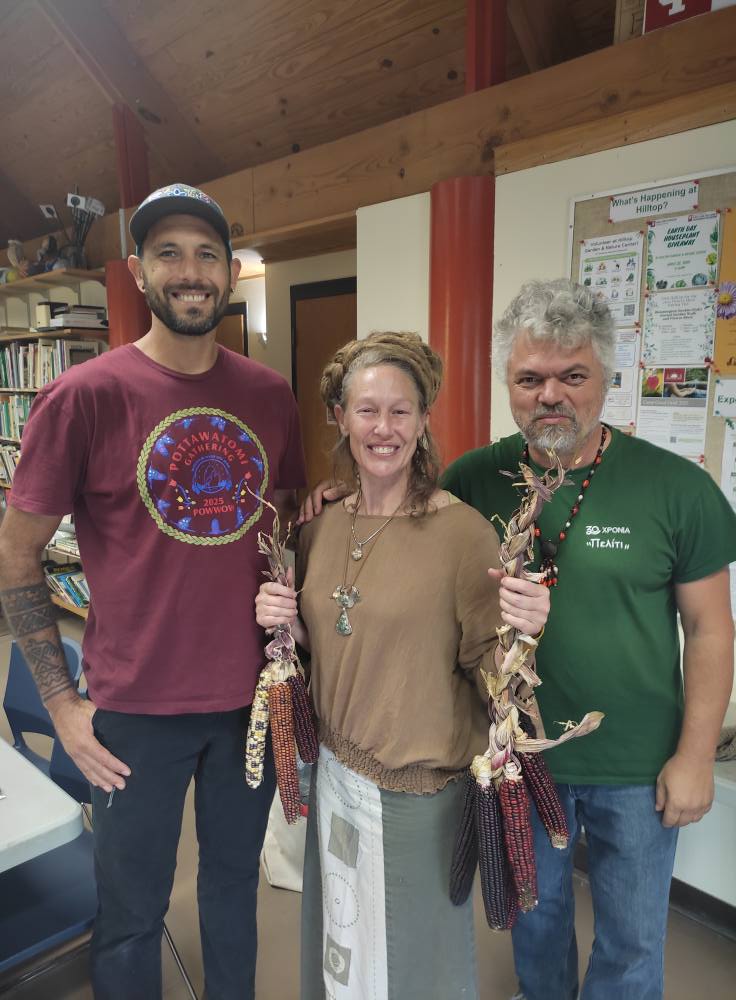
In Honor of Corn and Appreciation for the People around the World who Steward it
A summary of the Maize Gathering 2025 held Oct 17-18 at University of Indiana U. S.
I have recently returned from a trip to Bloomington Indiana U.S.A., where I was invited by University of Indiana Professors Dr. Olga Kalentzidou, Department of Geography and Dr. Keitlyn Alcantara, Department of Anthropology to participate in an international Maize Conference. The idea was to create a multi-faceted Maize Panel that would bring together a group of regional and global seed stewards, growers, chefs and activists to discuss the relationship between seed sovereignty, foodways, and culture. The panel included Chef Irad Santacruz, founder of the Center for the Study of Tlaxcaltecan Cuisine in Tlaxcala, Mexico, Kaya DeerInWater Potawatomi botanist and restoration specialist, Ryan Conway, Shawnee community organizer, farmer and independent scholar and myself Panagiotis Sainatoudis, founder of Peliti, an International Seed Saving Organization headquartered in Drama Greece.
My relationship with Dr. Kalentzidou started when she visited Peliti. Dr. Kalentzidou, originally from Evros Greece, is a professor in the Geography department at the University of Indiana. Our initial collaboration occured when she invited me to speak about Peliti to her students via a zoom meeting format. In 2024 and 2025 she came to the Peliti with a group of her students. On that occasion she shared information about the upcoming Maize Conference her university was hosting and invited me to attend to speak about Peliti and the work we do within the seed world .
Wednesday Oct. 15, 2025. Upon my arrival in America my first encounter was with a woman U.S. Customs Agent who was originally from Thessaloniki and who fortunately for me spoke Greek. This was the best thing that could have happened as she was very helpful and kindly assisted me in passing through the screening and security protocols associated with international travel. Afterwards I was happy to see Olga and her husband Stephen who were waiting to greet me at the Indianapolis airport. We drove to their home in nearby Bloomington where I had a good night’s rest.
Thursday, October 16 was a day of rest and adaptation. After breakfast Olga gave me a tour of her amazing home garden that included many Greek vegetable varieties! The garden was very colorful, full of greenery, large majestic trees and habitat for many different species of birds. A tall fence protected her garden from the hungry deer who would otherwise have made gardening impossible.
That afternoon we toured the city and visited a community vegetable garden. Olga informed me there are three community vegetable gardens in Bloomington. City residents who do not have their own land may reserve small garden beds in the community vegetable garden to grow their own vegetables. Community vegetable gardens exist throughout Europe, in the U.S.A., in Greece, etc., but what I saw for the first time was a thriving community orchard! The community orchard was started by a university student many years ago.
Thanks to that effort there are today many different varieties of fruit trees, where city residents can go and freely pick fruits, strawberries, blueberries, etc… Both the vegetable garden and the fruit orchard are open 24 hours a day. There has never been any vandalism or theft and there is no need for security cameras. I was very impressed by everything I witnessed there.
Afterwards we visited Indiana University in Bloomington. The university was founded on January 20, 1820, 205 years ago. Beautiful buildings, surrounded by greenery, a city within a city, Indiana University has 48,000 students
In the evening I met Frank Hess who spoke fluent Greek and teaches Greek Studies at the University. It is very interesting to meet people on the other side of the world who speak Greek and even more so those who teach it. Until a few years ago, Frang would bring groups of his students to Greece and visit businesses and cooperatives that had to do with food.
On October 17, the conference began with breakfast and introductions of the participating guests and presenters. There I met Keitlyn Alcantara, Olga’s colleague, with whom she organized the Maize Gathering. We all walked together to another building to inspect the room where the first meeting would take place and be broadcast out to the others via Zoom.
“This series of events aimed to bring together different perspectives on maize, from the industrialized history of Indiana’s “corn belt”, to the ways maize has been an ally to Indigenous and local food sovereignty. Food sovereignty movements across Turtle Island (one of the Indigenous names for North America ) support the idea that how we engage with maize is a choice that shapes our societies. In both North and South American indigenous cultures, the cycle of maize has, for millennia, structured time, social gatherings, and beliefs about the rhythms of life and death, guiding the care and tending of local ecologies and the communities who depend on them.
During the Maize Gathering, we will explore diverse relationships to maize, with guests from Greece, Mexico, as well as Potawatomi and Shawnee growers and culture keepers. Participants in this program will explore the following questions: How does the way we interact with maize shape our society? How does it shape our relationship to other-than-human beings? How does it shape sustainability and cultural well-being? This two day event will take place in different locations in and around campus, inviting participants to engage in a range of learning spaces and styles, and hear from a variety of maize experts, including growers, culture bearers, artists, activists, and academic experts”.
The event began with Ryan Conway of the Shawnee tribe burning leaves and offering a prayer in his native language. Until 1974, many Native peoples in the U.S.A. were prohibited from performing their ceremonies, their dances, speaking their language, cultivating their sacred plants, etc…
The Shawnee language is still spoken by 200 people. Most fluent Shawnee speakers are over 50 years of age. Rain is one of the people who speaks the language of his ancestors and organizes classes to preserve their language. The Shawnee consider their language to be an important part of their culture and that many elements of their culture are not well rendered in English. Something similar was said to me by an Indigenous person in Caracas, Venezuela at the World Conference for Mother Earth that I attended just prior to the Maize Conference, on October 9-10, 2025.
It is shocking to hear and see how Indigenous peoples constantly struggle to keep elements of their identity intact. Dominant societies will frequently translate indigenous words and expressions into their own Colonial vocabulary.Greek and other cultures, not knowing the origins or full history of these words, will perpetuate the misappropriation of these words into their own language. In the summer of 2025 I met Greeks who I could not understand what they were saying to one another because they used so much English terminology in their sentences. A lady said the term “seed bank” does not represent her values. She informed me that “seed bank” is a a colonial phrase that signifies seeds as merely a commodity. She preferred the expression “sacred space for seeds,” in this way she said “We may learn to see seeds differently and give them a different value. Today there is a great effort to redefine our relationship with nature through the eyes of our ancestors.”
This interaction reminded me of the time, in 2012, when I was invited to Mexico to talk about Peliti. On the last night I was invited to a traditional wedding ceremony, i.e. a wedding ceremony that was celebrated before the Spanish invasion. The foods they cooked were made from local products and originated in the region. The words they use make sure to be in the spirit before the European invasion. It was a culturally authentic and beautiful experience!
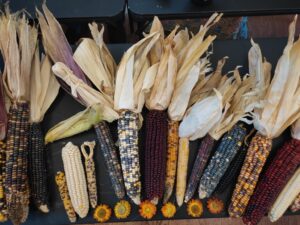
At the University of Indiana Maize Conference, Irad Santacruz Arciniega from Taxcal, Mexico, told us “We are the people of corn and corn is us. There are as many varieties of corn as there are people.” Irad grows 125 local varieties of corn! He is also a chef, and has managed to register Mexican cuisine as a UNESCO World Heritage Site. “We worked to change local laws to protect our corn, then we worked at the national level, and now we want to change the country’s constitution to make sure that we protect corn as part of our cultural heritage.”
After this informative and inspirational session, we went to the “First Nation House” for a rest and then to the Museum of Archaeology and Anthropology. There the three Indigenous growers, Ryan, and Kaya continued with their presentations. In the museum, was one of their exhibits of the white corn they use in their sacred ceremonies. We returned home late at night, I was tired but also very full from everything I had learned and experienced. I am grateful for the opportunity I was given to learn about these important movements and to meet so many dedicated and committed people fighting for their language, their traditions and their seeds.
On the morning of Saturday, October 18, 2025, We enjoyed a meal at the Therapeutic Garden where we continued to discuss and learn about how this space connects to our Greek, Mexican and Shawnee partners’ projects. We were also given the opportunity to make your own bouquet of flowers or herbs. All ages were welcome!
The Conference concluded with presentations from Irad Santacruz who spoke about the Tlaxcala Cuisine Study Center in Tlaxcala, Mexico. Then I spoke about the Peliti Seed Bank in Greece and invited everyone to join Peliti at the Peliti Seed Festival April 15 to 18, 2026. I concluded my talk with a theatrical play, where we all became seeds that grew and bore fruit thanks to the care and love of the growers. This fun theatrical activity was enjoyed by all and many of the participants expressed their heartfelt appreciation for my play and for Peliti’s presence at the Conference. This final session ended with Ryan and Andrea
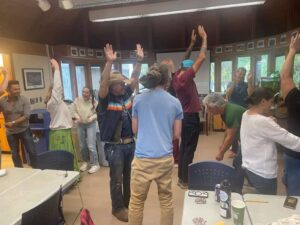
Conway speaking about their important work on the revival of Shawnee corn in Indiana.
Saturday, October 18, 2025 we visited the local farmers market in Bloomington. The market is held every Saturday and you can find vegetables, fruits, bread, dairy products, flowers and traditional seeds. Many of the growers grow traditional varieties of seeds and practice organic farming. Many growers do not bother with applying for “organic certification” because the process is expensive and growers are subject to constant and intrusive government inspections throughout the year. Many growers find it ironic how gmo farmers may grow crops and spray toxic chemicals without any kind of permit or over-sight. Surprisingly in America there is no labeling required of gmo food. While organic farmers are penalized with extra costs, a lengthy application process and annual reports in order to be allowed to label their vegetables as being organically grown.
The market growers come from a distance of less than a less than an hour and a half drive away – most of the produce is non-certified organic and grown very close to Bloomington. This was a very impressive market with many producers the likes of which you cannot find in Greece or other European countries. In Europe, in order for someone to sell traditional seeds, the seeds must be registered in the National or European Catalog. In the U.S.A. this is not the case, so producers can freely sell seeds from the local varieties they grow. In Europe, cash is gradually disappearing, at the Bloomington Farmer’s Market everyone paid in cash, which benefits the growers.
This Maize Conference in Indiana was the third time I have visited the U.S.A. representing the seed savers of Peliti. I have met incredible people and witnessed important citizen movements. Most of us in Greece think that the residents of the U.S. eat nothing except genetically modified food. During my visits I have met many vibrant people preserving local varieties and defending the right to freely grow and save seeds. I have found local potato varieties in Manhattan, New York, have seen local varieties of seeds being sold and exchanged at the local farmers market in Bloomington and know that local “seed libraries” are becoming very popular. It was reported that in the U.S.A. over 1,500 local tomato varieties are in circulation. All this shows me that a very robust movement in the preservation of seeds is alive and well and that seed saving is becoming a national tradition.
I will end this report by saying corn (Zea mays) is the plant that has changed my life. Corn continues to influence my life and has taken me on many journeys. What I learn and return home to share has a ripple effect. Like throwing a stone into a pond, the information and knowledge I acquire will be distributed in ever widening circles. It is my mission to inspire and affect through seeds the health and well-being of thousands of people around the world.
Thank you to Professor Ogla Kalentzidou and Keitlyn Alcantara for organizing such an outstanding gathering of corn people. A special thanks to my fellow presenters and to everyone who helped make this Maize Conference so meaningful and amazing. Thank you to John Caccia, director of Peliti-Idaho U.S.A. for his assistance in editing this article.
A-ho,
Panagiotis Sainatoudis